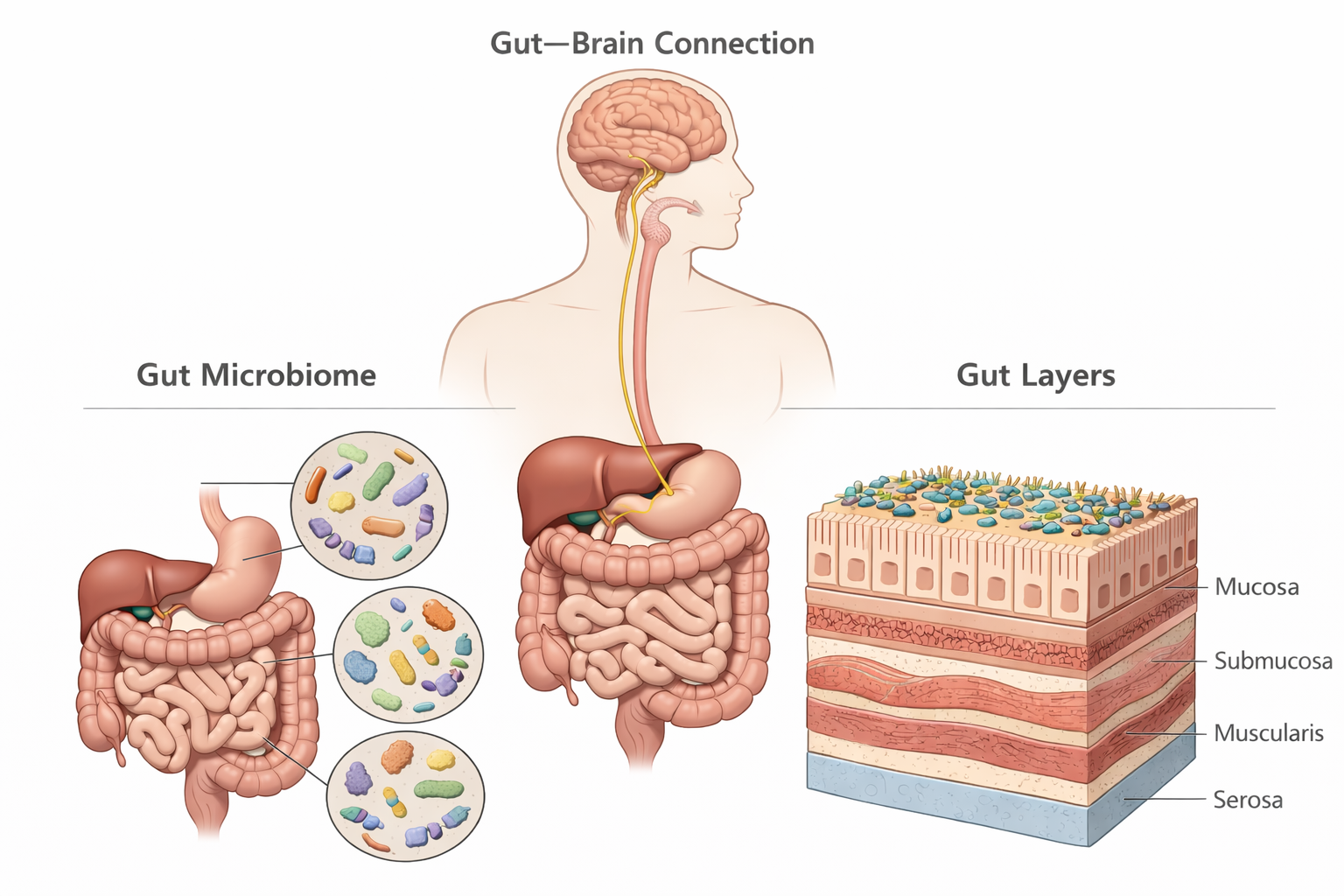
The gut is not just a digestive tube. In functional medicine, the gastrointestinal tract is viewed as a central regulator of digestion, immunity, metabolism, and neuroendocrine balance. A clear understanding of gut anatomy and physiology is essential before we can interpret dysfunctions such as dysbiosis, leaky gut, food intolerances, or chronic inflammation.
This article distills key concepts from a Functional Medicine lecture at VitaOne Education, focusing on how structure supports function, and how dysfunction arises when these systems are disturbed.
The Gut as a Functional Organ System
From a functional medicine perspective, the gut extends from the mouth to the anus. It is best understood as a hollow, continuous tube that separates the external environment from the internal body.
Although food passes through this tube, the gut lining itself is designed to be selectively permeable. Only specific, well-digested nutrients are allowed to cross into circulation. This selectivity is central to health.
Key functional roles of the gut include:
- Digestion and absorption of macronutrients and micronutrients
- Maintenance of the gut microbiota
- Preservation of intestinal barrier integrity
- Immunomodulation
- Regulation of the enteric nervous system
Any disruption in these roles can initiate or perpetuate disease.
Understanding the Gut Lining: Layer-by-Layer
To understand gut dysfunction, one must first understand the gut lining. The gut wall is not a single layer but a complex, multi-layered interface between the lumen and the bloodstream.
Columnar Epithelial Layer -
The innermost structural layer consists of columnar epithelial cells. These cells have villi-like projections that increase surface area and enhance nutrient absorption. This layer is directly responsible for transporting digested nutrients into circulation.
Damage here directly affects absorption and nutrient status.
Mucous Layer and Tight Junctions -
Covering the epithelial cells is the mucous layer, held together by tight junction proteins. These tight junctions regulate what can pass between cells.
When these junctions are intact, the gut remains impermeable to toxins and undigested food particles. When disrupted, intestinal permeability increases, commonly referred to as “leaky gut.”
Probiotic Layer -
Above the mucous layer lies the probiotic or microbiome layer. Beneficial bacteria colonize this space and play a critical role in digestion, fermentation, immune signaling, and protection against pathogens.
Secretory IgA Layer -
The outermost functional layer consists of secretory IgA. This antibody helps maintain immune tolerance, prevents pathogen attachment, and protects the integrity of the gut lining.
Together, these layers create a dynamic and protective barrier between the gut lumen and systemic circulation.
Gut Surface Area: Why It Matters
If the gut lining were laid flat, its surface area would measure approximately 30–40 square meters, comparable to a tennis court. This enormous surface area explains why the gut is such a powerful immune and metabolic organ.
Because of this scale, even minor disruptions in gut integrity can have widespread systemic effects.
Where Is the Gut Microbiome Located?
A common misconception is that the microbiome exists evenly throughout the gut. In reality, microbial distribution varies significantly.
- The large intestine contains the highest density of gut microbes
- The small intestine contains fewer microbes, with the duodenum having the lowest
- The jejunum and ileum contain more bacteria than the duodenum but far less than the colon
This distribution is essential for normal digestion and fermentation. Overgrowth in inappropriate areas, such as the small intestine, can lead to symptoms and dysfunction.
Digestion and Absorption: A Functional Overview
Carbohydrate Digestion
Carbohydrate digestion begins in the mouth with salivary enzymes. This initial step prepares carbohydrates for further breakdown in the intestines.
Protein Digestion and the Role of Stomach Acid
Protein digestion begins in the stomach and depends heavily on adequate hydrochloric acid (HCL) production.
HCL serves several key purposes:
- Denatures proteins
- Activates digestive enzymes
- Signals proper closure of esophageal and pyloric sphincters
Low stomach acid, known as hypochlorhydria, leads to poor protein breakdown, reflux symptoms, and downstream digestive issues. Importantly, protein malabsorption is often due to low stomach acid rather than pancreatic enzyme deficiency.
Fat Digestion and Bile
Bile is essential for fat digestion and absorption. While bile is produced in the liver, a large portion is recycled through the intestine via enterohepatic circulation.
Impaired bile flow or recycling leads to fat malabsorption, nutrient deficiencies, and altered microbiome balance.
Gut Barrier Dysfunction and Systemic Inflammation
When the gut barrier is compromised, substances that should remain inside the gut lumen can enter circulation. These include:
- Undigested food proteins
- Bacterial fragments
- Microbial toxins
These substances travel through the portal circulation to the liver and then into systemic circulation, triggering chronic inflammation and immune activation.
This mechanism explains the gut–liver connection and why gut dysfunction is often associated with systemic inflammatory conditions.
Gut–Brain Axis and the Enteric Nervous System
The gut has its own nervous system, known as the enteric nervous system (ENS). It communicates bidirectionally with the brain, primarily via the vagus nerve.
Inflammation in the gut can alter signaling through this pathway, contributing to:
- Anxiety and mood disturbances
- Visceral hypersensitivity
- Functional gut disorders such as IBS
Patients may experience pain or discomfort even in the absence of visible pathology due to nervous system dysregulation.
Development of the Microbiome Across the Lifespan
Microbiome development begins at birth. Vaginal delivery exposes the newborn to maternal microbes, helping establish the gut microbiome.
As solid foods are introduced gradually, microbial diversity expands. Diet, environment, medications, and lifestyle continue to shape the microbiome throughout life.
This adaptability is why functional medicine focuses on restoring balance rather than suppressing symptoms.
Summary: Why Gut Physiology Comes First
Before addressing gut-related conditions, it is essential to understand normal gut anatomy and physiology. Structure determines function, and dysfunction arises when these systems lose balance.
Key takeaways:
- The gut is a selectively permeable, highly regulated organ
- Barrier integrity is central to immune and metabolic health
- Digestion depends on coordinated function of acid, enzymes, bile, and microbes
- Gut dysfunction can drive systemic inflammation and neurological symptoms
A strong foundation in gut physiology allows practitioners to interpret symptoms and labs with clarity and precision.
To deepen your understanding of functional medicine principles and clinical application, explore structured learning programs at VitaOne Education.
Visit https://vitaone.in/education